
Running out of hot water halfway through a shower is usually not caused by Florida’s climate. More often, it happens because the water heater cannot keep up with the household’s actual usage. A tank that worked well for two people may begin struggling when a family grows, relatives move in, teenagers take longer showers, or appliances are regularly used at the same time. Even a relatively new system can feel inadequate when the home’s daily routine has changed since it was installed.
Choosing the best water heater size for a Florida home involves more than counting the number of people who live there. Household size is an important starting point, but the number of bathrooms, back-to-back showers, laundry habits, fuel source, recovery rate, available installation space, and type of water heater all affect the final decision. A properly sized system should provide enough hot water during the busiest part of the day without being unnecessarily large, expensive, or difficult to install.
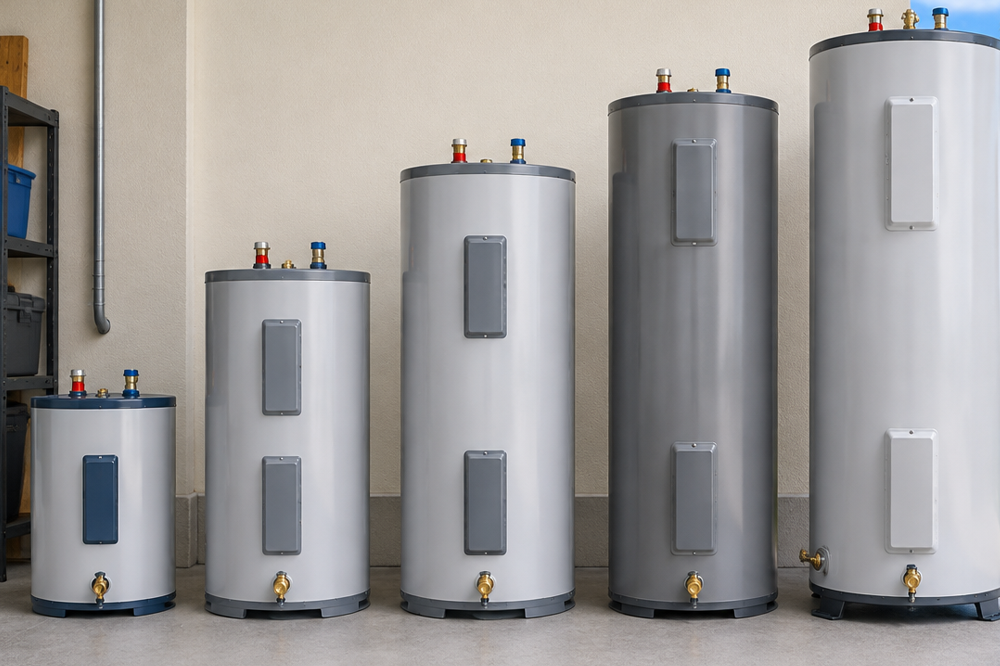
As a general water heater sizing guide, a 40-gallon tank may be appropriate for a smaller household with moderate hot water use, while a 50-gallon tank is often a more comfortable starting point for families of three or four. Larger households, homes with several bathrooms, and families that frequently use multiple hot water fixtures at once may need a 60-, 65-, 75-, or 80-gallon system. A properly sized tankless unit may also be considered when continuous hot water delivery and available installation capacity make it practical.
These are only starting ranges. The correct answer to “what size water heater do I need?” depends on the specific water heater’s first-hour rating, recovery rate, household schedule, fuel type, installation conditions, and manufacturer recommendations. ENERGY STAR guidance emphasizes evaluating first-hour rating and expected periods of high demand rather than relying on tank capacity alone.
A practical starting point for conventional tank systems is:
A professional evaluation is still recommended before scheduling a water heater installation, especially when changing tank size, fuel source, or water heater technology.
Household size matters because every additional person generally adds showers, handwashing, laundry, cooking, and cleaning to the home’s hot water demand. However, two families of the same size may use very different amounts of hot water. A family of four that showers at different times may be comfortable with a smaller system than a family of three that takes consecutive morning showers while running the dishwasher.
The best water heater size for a family should therefore be based on both the number of occupants and how they use hot water. Consider whether the home has young children, teenagers, frequent guests, a large soaking tub, or family members who prefer longer showers. It is also important to think ahead. Replacing a tank with the smallest model that works today may result in another capacity problem if the household is expected to grow.
When reviewing household needs, ask:
These questions often provide a more accurate picture than household size alone.
The number of bathrooms does not automatically determine tank size, but it can indicate how much simultaneous demand the system may experience. A one-bathroom home naturally limits how many showers can operate at once. In contrast, a three-bathroom home may have multiple showers, sinks, and tubs drawing hot water during the same period.
ENERGY STAR sizing guidance for heat pump water heaters considers both bedrooms and bathrooms because the combination provides a better estimate of potential demand. Its guidance also recommends increasing capacity when occupants are likely to have high-use periods, such as families with teenagers or people who regularly take baths.
Fixture type matters as well. A large soaking tub can use significantly more hot water during a single draw than an ordinary sink. Similarly, two showers running at once may place more pressure on the system than several smaller uses spread across the day. This is why an on-site evaluation should account for the home’s actual bathrooms and fixtures rather than simply matching the capacity of the old unit.
Water heater sizing is primarily about handling peak demand. A household might use a reasonable amount of hot water over an entire day but still overwhelm the system during a busy 45-minute morning period. For example, two showers, a dishwasher cycle, and a load of laundry may create more demand than the tank can supply before it has time to reheat incoming water.
For storage water heaters, the first-hour rating is one of the most useful specifications to review. It represents how much hot water a fully heated storage system can provide during the first hour of use, including stored water and water reheated during that period. Two 50-gallon models can therefore perform differently if one has a higher first-hour rating.
Homeowners can estimate peak use by identifying the busiest hour of a typical day and listing everything that may operate during that period. A qualified plumber can then compare the estimated demand with the first-hour ratings of available models.
Tankless systems are sized by gallons per minute and temperature rise rather than storage gallons. The correct capacity depends on how many fixtures may operate simultaneously, their flow rates, incoming water temperature, desired output temperature, and available gas or electrical capacity.
It may be enough for three people with moderate use and staggered showers. A 40-gallon system may struggle when several showers and appliances operate within the same hour. Review the model’s first-hour rating and the household’s peak usage before deciding.
Not necessarily. A larger tank stores more water, but recovery rate, first-hour rating, efficiency, fuel source, maintenance condition, and household demand also affect performance. An unnecessarily large unit may cost more to purchase and may create installation challenges.
A 40 gallon water heater installation is often considered for one- to three-person households, smaller homes, condominiums, guest spaces, and families with moderate usage. It may work well when showers are relatively short, appliances are used at different times, and the current 40-gallon system has consistently met the household’s needs.
However, choosing a 40-gallon tank based only on the existing tank size can be a mistake. The old unit may already be undersized, or sediment buildup and worn components may have reduced its usable capacity. Before replacing it with an identical model, consider whether the household has experienced lukewarm water, delayed recovery, or repeated shortages.
The first-hour rating should also be reviewed. A higher-performing 40-gallon gas model, for example, may deliver a different amount of usable hot water than a standard electric model with the same storage capacity. Anyone considering a conventional system can review the differences between available tank water heater options before selecting a replacement.
A 50 gallon water heater replacement is a common option for households of approximately three or four people, particularly when morning showers occur close together. It can also provide a helpful capacity buffer for a smaller household that uses a large bathtub, hosts guests, or frequently runs appliances during shower times.
Moving from 40 gallons to 50 gallons may improve comfort, but the larger tank must physically fit the available space. The installation may also involve different connections, clearances, drain-pan dimensions, electrical requirements, venting, or structural considerations. Therefore, a larger tank should not be ordered until the installation area has been measured and inspected.
A professional water heater replacement should account for both present needs and reasonable future demand. The goal is not simply to install the largest tank possible. It is to choose a model with enough delivery capacity while avoiding unnecessary installation complications and standby energy use.
Recovery rate describes how quickly a water heater can heat new cold water after hot water leaves the tank. This specification helps explain why tank capacity does not tell the whole story. A system with a strong recovery rate can replenish usable hot water faster during consecutive showers, while a slower-recovering unit may require more time between heavy draws.
Fuel type, heating-element capacity, burner input, water temperature settings, incoming water temperature, and model design can all affect recovery. Consequently, homeowners should compare the complete performance specifications of individual models rather than assuming every water heater of the same size will perform equally.
Recovery becomes especially important for homes with concentrated usage. If five people shower one after another every morning, a tank with adequate storage but slow recovery may still disappoint. Conversely, a smaller system with strong recovery may serve a moderate-use household better than its gallon rating initially suggests.
Electric and gas storage water heaters are both commonly used, but they may have different recovery characteristics and installation requirements. A replacement is usually simplest when it uses the same fuel source and fits the existing connections. Changing from electric to gas or gas to electric may require electrical work, gas-line modifications, venting, equipment relocation, or other upgrades.
Because model performance varies, homeowners should compare the first-hour rating, recovery information, Uniform Energy Factor, and estimated operating cost. The yellow EnergyGuide label provided under Federal Trade Commission requirements helps consumers compare energy use among similar appliances, although the displayed operating cost is an estimate based on typical use and national energy prices. Actual Florida utility costs and household habits may differ.
Gas availability should not be assumed simply because another appliance uses gas. Similarly, an electrical panel may not have sufficient capacity for every type of electric or hybrid upgrade. These conditions should be verified before selecting a model.
Tankless water heaters are not sized by storage capacity. Instead, they are selected according to gallons per minute and the required temperature rise. The installer must determine how many fixtures could operate simultaneously and how much hot water each fixture requires. ENERGY STAR notes that tankless sizing should consider whether showers, sinks, dishwashers, and washing machines may run at the same time.
A tankless system can be a good solution for certain Florida homes, but it is not automatically the right choice for every household. Gas-line capacity, electrical service, venting, water quality, installation location, and simultaneous demand must be evaluated. Homeowners exploring this option should review how tankless water heaters differ from traditional storage systems.
Hybrid or heat pump water heaters typically use a storage tank but heat water differently from standard electric-resistance models. They are often available in 50-, 65-, and 80-gallon capacities, and ENERGY STAR commonly recommends upsizing when transitioning from another system or when the household has high peak demand. A professional can help determine whether a hybrid water heater is suitable for the home.
Water heaters in Florida may be located in garages, utility rooms, interior closets, exterior closets, attics, or condominium mechanical spaces. A model that meets the household’s capacity requirements may still be unsuitable if it is too tall, wide, or difficult to access.
Measure more than the footprint of the existing tank. The installer may need space for connections, valves, a drain pan, service access, ventilation, condensate drainage, or future removal. Heat pump models also require adequate airflow and can release cooler, drier air while operating. ENERGY STAR recommends following each manufacturer’s clearance and air-volume requirements and notes that garages and utility spaces can be practical locations in warm climates when properly configured.
Local code, manufacturer instructions, and property rules must also be considered. Condominium associations may have additional requirements regarding shutoff valves, drain pans, leak detection, installation hours, or contractor documentation. The current Florida Building Code and the applicable local jurisdiction should be consulted when determining installation and permitting requirements.
An undersized water heater usually becomes noticeable during periods of concentrated use. Homeowners may begin adjusting their schedules around the system, waiting between showers, avoiding laundry in the morning, or increasing the temperature to compensate for limited capacity.
Common signs of an undersized or poorly performing system include:
However, these symptoms do not always mean the tank is too small. A damaged heating element, thermostat issue, burner problem, broken dip tube, sediment accumulation, or other mechanical condition can create similar symptoms. Scheduling water heater repair may resolve the problem without increasing tank size.
Water heater size is only one factor in the cost and timeline of a project. Replacing a unit with a similar model in an accessible location is typically more straightforward than changing capacity, fuel source, or technology.
If you’re planning a new system, our team handles water heater installation tampa from sizing to same-day scheduling.
Factors that may increase or decrease complexity include:
Final costs and timelines depend on the selected equipment, existing system condition, property layout, local requirements, provider, and any additional work discovered during inspection. A written estimate should explain what is included and identify potential upgrades before work begins whenever possible.
Even a correctly sized water heater may eventually perform poorly without appropriate maintenance. Sediment can collect at the bottom of a storage tank, particularly where mineral content is present in the water supply. Over time, buildup may reduce heating performance, contribute to noise, or place additional strain on the system.
The appropriate maintenance schedule depends on the equipment, water conditions, manufacturer instructions, and usage. Professional water heater maintenance may include inspecting valves and connections, checking for corrosion or leaks, evaluating temperature settings, and reviewing the condition of key components. When appropriate for the model and its condition, water heater flushing may also help remove accumulated sediment.
Maintenance cannot make an undersized tank larger, but it can help determine whether poor performance is caused by capacity, component failure, or neglected service.
Homeowners should contact a qualified professional when changing water heater size, switching fuel sources, considering a tankless or hybrid system, dealing with gas or electrical connections, or noticing leaks, corrosion, combustion concerns, unusual noises, inconsistent temperatures, or repeated loss of hot water.
Water heaters involve pressurized water, high temperatures, electricity, and sometimes gas and combustion venting. Incorrect installation or repair can cause property damage and serious safety risks. A professional can inspect the current system, calculate peak demand, verify available space and utilities, compare first-hour ratings, and determine what local requirements apply.
Florida homeowners, including those looking for water heater service in Broward County, should have the property evaluated before purchasing equipment when there is any uncertainty about size or installation compatibility.