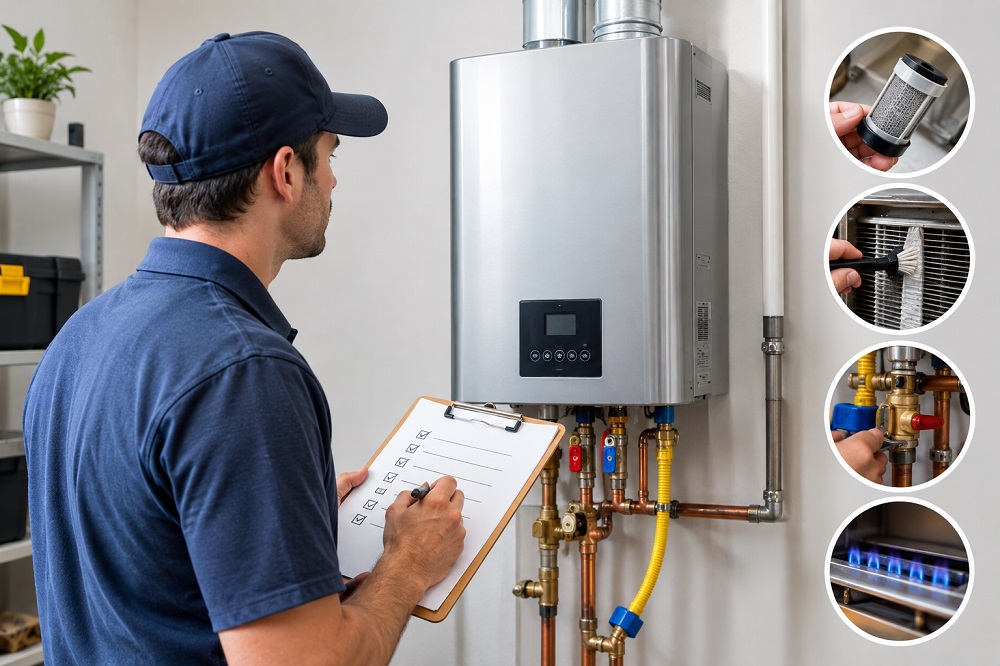

Tankless water heaters get marketed as low-maintenance, and compared to a traditional tank, that’s fair. But “low-maintenance” doesn’t mean “no-maintenance,” and this is where a lot of homeowners in Boca Raton and Plantation end up caught off guard a few years in. Skip maintenance long enough and you start losing the efficiency and lifespan that made tankless worth the switch in the first place.
Here’s what actually needs to happen, and roughly how often.
Florida’s water isn’t exactly gentle on plumbing systems. Hard water is common across a lot of the state, and mineral content builds up inside a tankless unit’s heat exchanger over time. Left unchecked, that buildup reduces efficiency, forces the unit to work harder to hit the same temperature, and eventually shortens its lifespan considerably. A unit that could otherwise run for 15 to 20 years can end up needing major repairs, or even replacement, well before that if maintenance gets skipped entirely.
This is the single most important maintenance task for a tankless unit, and it’s usually recommended once a year, though homes with particularly hard water sometimes benefit from doing it more often.
The basic process looks something like this:
This process clears mineral scale off the heat exchanger, which is really what keeps the unit running efficiently year after year.
Most tankless units have an inlet water filter designed to catch sediment before it enters the system. That filter needs periodic cleaning, generally every few months depending on water quality, since a clogged filter restricts flow and can trigger error codes or reduced performance. This is usually one of the simpler maintenance tasks, just remove the filter, rinse off any buildup, and reinstall it.
For gas-powered tankless units, proper venting matters for both performance and safety. Over time, vents can accumulate dust, debris, or in some cases, nesting insects or small animals, particularly in outdoor installations common across Florida homes. It’s worth periodically checking that vent terminations are clear and unobstructed, and that combustion air intakes aren’t blocked by landscaping, storage items, or debris.
Some of this maintenance is reasonable for a comfortable homeowner to handle, cleaning the inlet filter, for example, is fairly straightforward. Descaling is a bit more involved since it requires the right equipment and careful attention to the shutoff sequence, but plenty of homeowners do manage it themselves with the right guidance.
Where professional maintenance really earns its keep is with annual inspections that check for things a homeowner might miss, like early signs of a failing component, gas line issues, or venting problems that aren’t obvious without disassembling anything. A professional visit once a year, even if you’re handling some maintenance yourself in between, tends to catch small problems before they become expensive ones.
A simple routine to keep on hand:
A tankless water heater can genuinely run for well over a decade without major issues, but that longevity depends on actually keeping up with the maintenance it needs, not just assuming “tankless” means “hands-off.” Florida’s water conditions make this especially true, since scale buildup happens faster here than in a lot of other regions. A little routine upkeep goes a long way toward protecting the investment. Pompa Plumbing Group can handle the annual descaling and inspection side of things for homeowners who’d rather not deal with the equipment and shutoff sequence themselves.
Most manufacturers recommend flushing and descaling once a year, though homes with particularly hard water may benefit from doing it more frequently.
Regular maintenance includes annual descaling, periodic inlet filter cleaning, and checking vents and combustion air pathways for gas units.
Some tasks, like cleaning the inlet filter, are manageable for most homeowners, while descaling requires more equipment and care with the shutoff process.
Mineral scale builds up inside the heat exchanger, reducing efficiency and shortening the unit's lifespan, sometimes significantly over time.