
Is your water heater leaking, rusting, or running out of hot water faster than usual? Now you’re stuck trying to figure out whether to repair your water heater or get a new one.
Repairing your water heater may cost less, but if it’s getting old or keeps breaking down, you might be better off replacing it.
For Florida homeowners, the right decision often depends on several factors, including the unit’s age, the nature and extent of the issue, the cost of repairs, current condition, and energy efficiency.
In this guide, we’ll explain when water heater repair services are a practical choice, when replacement may be the better investment, and how to determine the most cost-effective solution for your home.
If your water heater is fairly young, only one part has gone bad, and the tank is in good shape, repairing it usually makes more sense than buying new. Here are the problems we see fixed most often:
Note: A symptom such as inconsistent hot water doesn’t automatically mean the heater has reached the end of its life
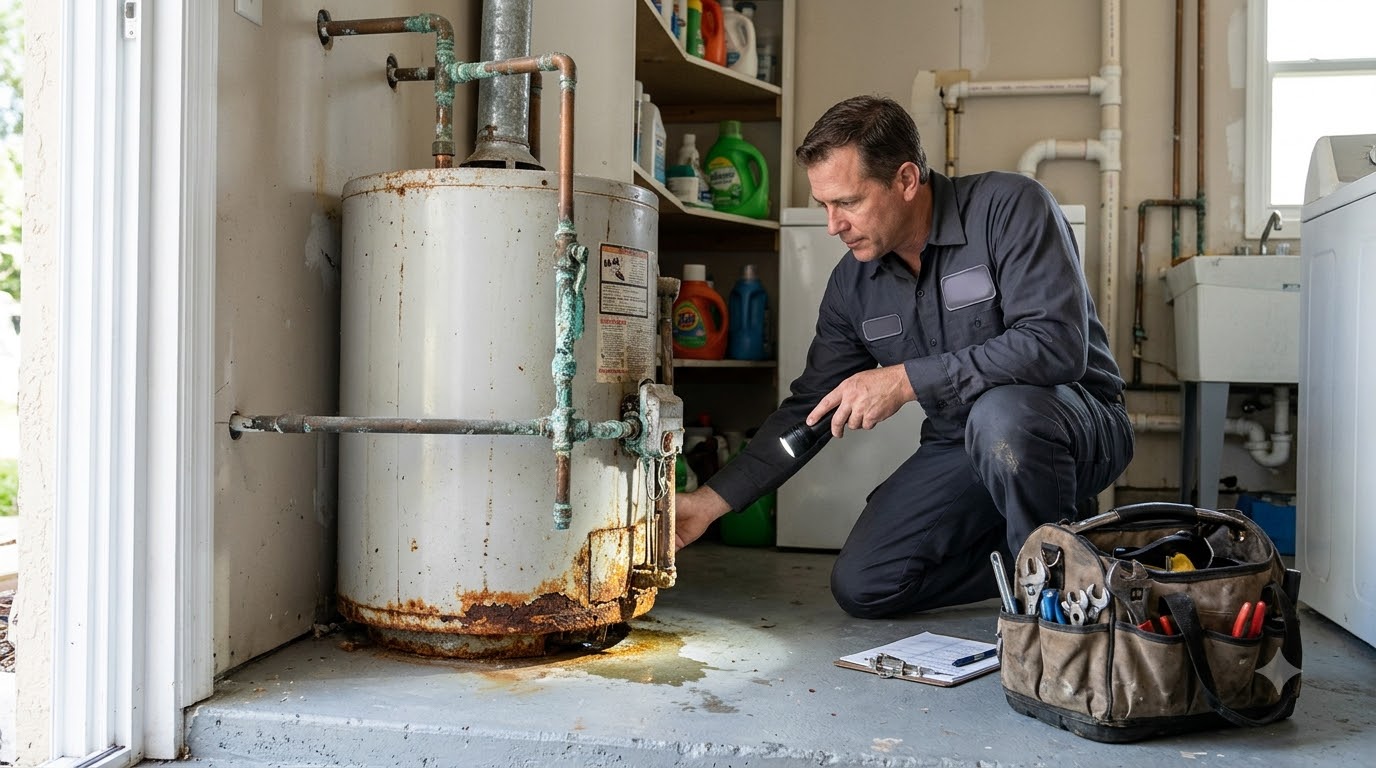
Consider water heater replacement services if it’s showing significant wear, breaking down repeatedly, or costing too much to repair.
Watch for these warning signs:
Note: Water around the unit does not always mean the tank has failed. Water may come from a supply connection, drain valve, temperature-and-pressure relief valve, or condensation. A plumber can locate the source and determine whether a repair is possible.
If the storage tank itself is leaking, replacement is generally the appropriate solution.
A six-year-old electric water heater suddenly stops producing hot water. There are no leaks or rust, and the plumber finds that the heating element is broken. The rest of the heater is in good shape. In this case, repairing it may be the better choice if the repair cost is reasonable.
An older water heater has needed several repairs over the past year. Now, water is leaking from the storage tank itself, and the unit is no longer heating consistently. A leaking tank cannot be fixed by replacing an external valve or fitting. In this situation, replacement may be an appropriate option because repairing external fittings will not restore the failed tank.
Note: When deciding between water heater repair vs. replacement, consider the source of the problem, the unit’s current condition, previous repair costs, and the price of a replacement. A single faulty component may justify a repair, while tank damage and recurring breakdowns can make replacement the long-term choice.
Average Lifespan of Tank vs. Tankless Water Heaters
Conventional storage-tank water heaters typically last around 10–15 years, while tankless water heaters can last around 20 years, according to the U.S. Department of Energy. Actual service life varies depending on the model, maintenance, water quality, and usage. These are estimates rather than fixed replacement deadlines.
These are estimates, not automatic replacement deadlines. Actual lifespan depends on the model, water quality, maintenance, and usage. These are general estimates, not fixed replacement deadlines.
Check the manufacturer’s label or documentation to establish the unit’s age. Then consider its condition to know how many more years it is likely to last.
Important: Age alone does not automatically mean a water heater needs replacement. For example, an eight-year-old heater with a small problem may still be worth fixing if it has been well maintained. But if your heater is old, has rust, breaks down often, or needs costly repairs, replacing it may be the better choice.
In Florida, water heater repairs usually cost around 200–1,000. Replacing a standard tank water heater may cost 1,200–2,500, while installing a tankless water heater can cost 3,000–6,000.
The final cost depends on the type of heater, the parts and labor needed, and how much work is involved. If extra plumbing, electrical, gas line, or venting work is needed, the cost may be higher.
Ask your plumber to explain the costs, including the inspection, parts, labor, and any extra charges. If you’re getting a new water heater, ask for the full price, including installation, so you know how much you’ll need to pay.
Florida has hot, humid summers and mild winters, with most rainfall occurring during the summer months, according to the NOAA climate report for Florida. All of these can influence how a water heater performs.
Before approving major work, ask your plumber:
When Does the 50% Rule Make Sense?
If a repair approaches half the water heater replacement cost in Florida, compare both options carefully. This is a budgeting guideline, not a strict rule. A small repair may be a good choice if the heater is in good condition, but an old or badly damaged heater may need more repairs later.
Consider the next few years of ownership, too. If your old heater breaks down often or uses too much energy, replacing it may save you money and give you fewer problems. The savings will depend on your current heater, the new model, energy costs, and how much hot water you use.
Not sure whether to repair or replace your water heater? Pompa Plumbing can help you. Our technicians are trained to check your water heater, find the problem, and explain suitable options. We also provide clear pricing upfront so you know what to expect before the work begins.
Whether you need a repair, a replacement, a new water heater installation, routine maintenance, a water heater flush, a tune-up, or emergency service, our team is here to help homeowners and businesses across Florida. With more than 10,000 homeowners and businesses served, we’re ready to help you get your hot water back on track.
Not sure which option makes the most sense for your home? Contact Pompa Florida for water heater service and get a clear idea of your next steps.